

It’s easy to get caught up in the excitement of doing WAY more in less time.
Work that once required days of data cleaning, analysis, modeling, presentation building, and insight development can now be delivered in hours with AI. Managers want faster results, teams are experimenting with new tools, and leaders are under pressure to demonstrate that their organizations are AI-ready. I see it every day at work!
Don’t get me wrong, I’m as excited about AI as anyone! AI can remove repetitive work, accelerate analysis, and document meetings (thank you, because I was never a good note-taker). It can support coding and help teams move from an idea to a prototype faster than ever. But speed introduces a new challenge: When the cost of producing work falls, it also becomes easier to do the wrong work faster!
Over the past year, many of the AI adoption challenges I’ve observed across organizations have not been caused by a lack of tools. They come from how success is measured, how problems are prioritized, the strength of the underlying data foundation, and whether successful experiments can actually scale.
Here are five common mistakes organizations make with AI adoption—and practical strategies to overcome them
1. Measuring AI Activity Instead of Business Value
As McKinsey reports, many companies (64%) say AI is driving innovation, but just 39% report a measurable impact on earnings. It’s easy to track licenses activated, prompts submitted, tokens consumed, and time spent with AI tools. However, real success should be measured through business outcomes: revenue, cost reduction, speed, quality, or customer outcomes.
In a recent project, I was able to run an analysis in one day instead of one week. That gave me stronger evidence to recommend that my client keep the experiment running longer before pulling back spending. The value wasn’t simply completing the analysis faster. It was that speed allowed me to make a recommendation in record time based on data.
2. Implementing AI Before Understanding the Real Bottlenecks
There is growing pressure to demonstrate AI adoption, especially as organizations commit to AI transformation. But understanding a company’s deeper problems and workflows is often overlooked or deprioritized.
Mapping workflows can reveal where teams lose time, where decisions get delayed, and where repetitive work creates unnecessary costs. Only then can organizations determine where AI helps. The goal shouldn’t be to automate tasks because we need to prove we’re AI-ready. It should be to focus on problems that matter the most and align AI budgets, tools, and teams with them. Finally, when we recognize that different problems require very different solutions and tools, we start having a true AI strategy.
Author of this post, Daniela Matinho, is going to be a speaker during the upcoming AI Loves Data San Francisco conference. Secure your spot today!
3. Giving Employees Tools Without AI Training
Everyone is self-taught these days, especially if you work in tech. You have to be! But access to several AI tools can also create confusion and fragmented experimentation.
Organizations need to train employees not only on how to use AI, but when to use it, which tools are appropriate for each task, how to evaluate outputs, and when human judgment is required.
As ATN reports, 82% of enterprise leaders say their organization provides AI training; however, 59% still report an AI skills gap. So, the training is happening but the gap isn’t closing because practical application does not follow. Training needs to be connected to real work. Learning how to write a prompt in a generic course is different from understanding how AI can improve the workflows and decisions employees encounter every day.
The goal is not simply AI literacy. It is building the capability to apply AI consistently and responsibly.
4. Ignoring the Data and Governance Foundation
AI does not fix poor data. I feel like I repeat this every time I speak about AI, but building on top of crap will only give you crap × 2—except now you can produce it faster and at scale.
The hardest and longest step is often fixing the data foundation, which many organizations have postponed for years. Historical data quality, lineage, permissions, and appropriate data sharing can completely change the quality and reliability of AI outputs. So, start there!
5. Allowing Experimentation Without Clear Scalability is a Recipe for Failure
AI is accessible, which is a great thing. But, just like with social media, more is not always better. Hundreds of disconnected experiments can create a lot of activity without creating organizational learning or business value.
The challenge is creating a path from experimentation to scale. Organizations MUST identify high-value use cases, bring together cross-functional teams, run structured pilots and hackathons, and measure outcomes consistently.
Successful pilots need a clear path to scale, while unsuccessful ones can still generate insights for future decisions. Experimentation creates possibilities. Structure, measurement, and feedback are what turn those possibilities into scalable solutions.
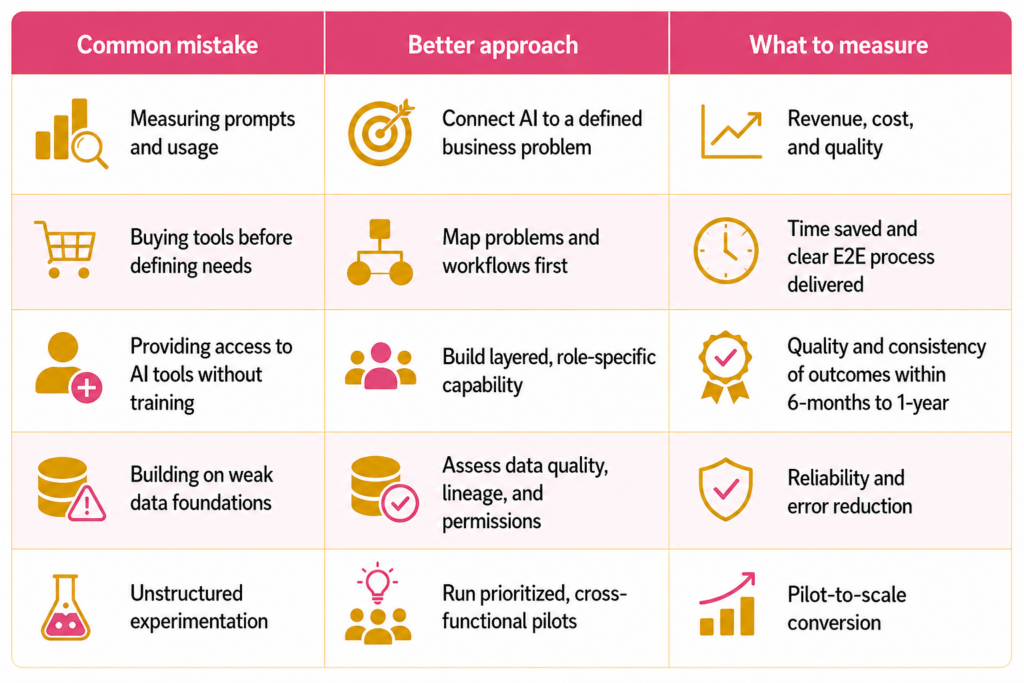
If you’re responsible for implementing AI on your team—or reporting on its success—start by mapping your workflows. Understand where the real bottlenecks are, which problems consume the most time and resources, and where AI has the potential to create meaningful value.
A Practical Five-Step Framework is:
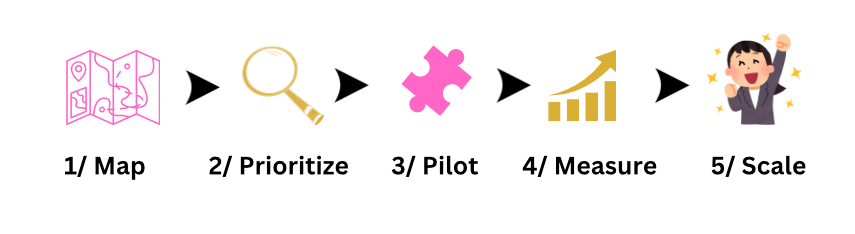
Quick wins have a role. Automating a repetitive 10-minute task can add up across hundreds of employees. But organizations need to look beyond individual productivity and identify larger systemic opportunities: a data-cleaning process that delays analysis by days, a pipeline that repeatedly breaks, or a decision-making process limited by fragmented information. The goal is not to implement AI everywhere. It is to identify where AI can create meaningful change, build pilots around these opportunities, measure their impact, and scale what works.
The organizations that succeed with AI will not necessarily be the ones that try the most tools or generate the most prompts. They will be the ones that make the best decisions about where AI creates value, where there is opportunity to scale, and where human judgment matters most.
Author: Daniela Matinho
Daniela Matinho, is going to be a speaker during the upcoming AI Loves Data San Francisco conference. Secure your spot today!