
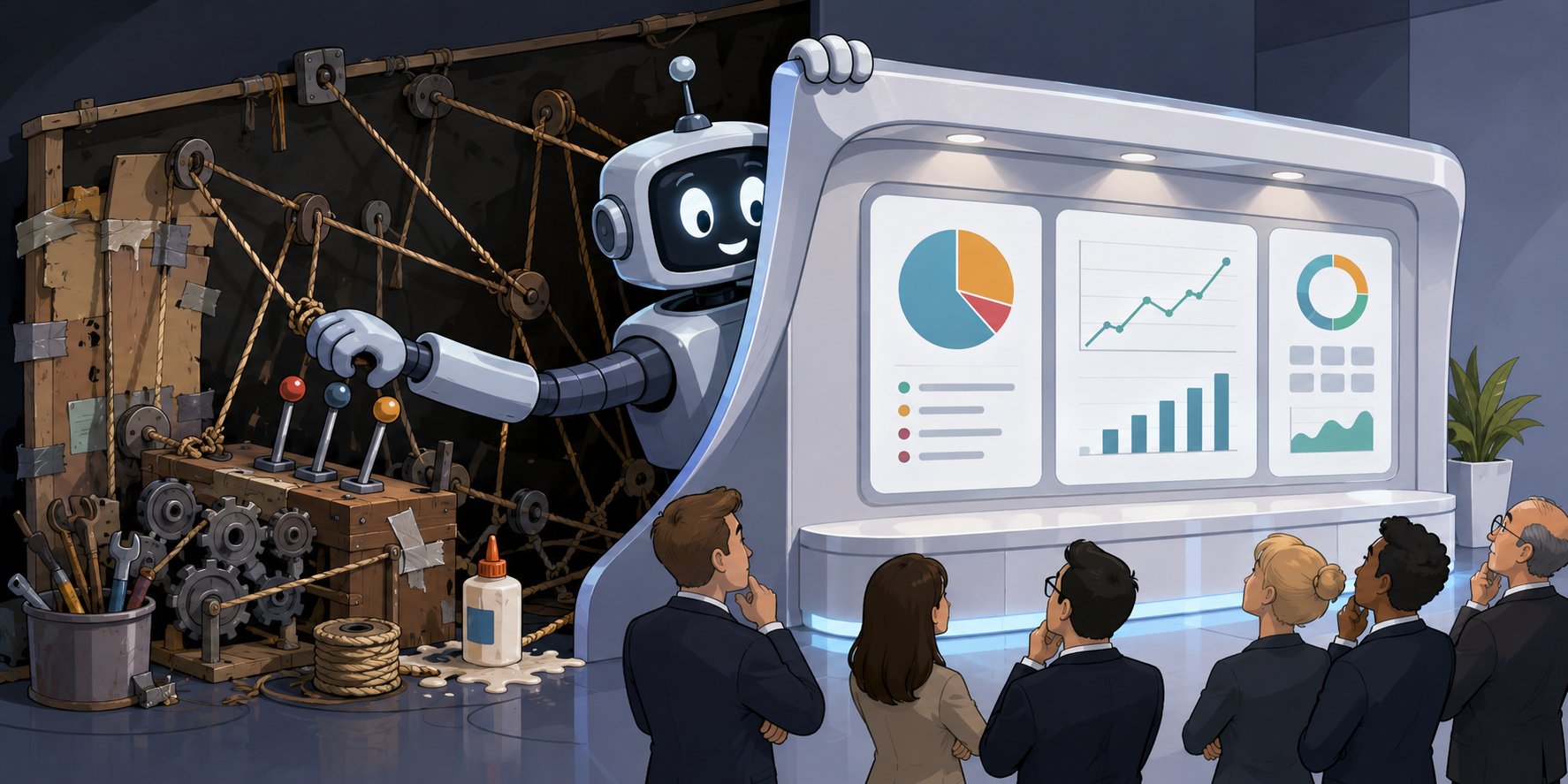
Your best analyst gets things wrong. Misremembered figures. Stale assumptions. A confident error in a board deck. You trust them anyway, and the reason explains more about enterprise AI than any benchmark does.
You trust them because their errors get caught. They cite their sources. They answer when you ask why. Their work leaves a trail someone else can walk. Enterprises never ran on infallible people. They ran on verification. Reviews, sign-offs, show-your-work norms. All of that machinery assumes people will be wrong and makes the errors cheap to find.
AI landed in the enterprise before the verification machinery was ready. Research surveys document hallucination rates that vary widely with task type. A Stanford-led study of purpose built legal AI tools, published in the Journal of Empirical Legal Studies, found hallucinated output on 17 to 33 percent of research queries depending on the tool. Those numbers look damning until you remember that human error on the same work was never zero. The bare model fails a different test. A model answering from its parameters alone cannot reliably show the source behind a claim. Ask it why, and it generates a justification the same way it generated the answer: fluent and unverifiable. Without source-linked evidence, a reviewer is left reconstructing the work to check it.
If checking costs as much as doing, AI saves nothing
That sentence is the whole economics of the problem. When verifying an AI answer takes as long as producing it without AI, the deployment has no yield. It just moves the labor from doing to checking. This burden may help explain why so few companies get past experimentation. McKinsey reports that 1 percent of surveyed C-suite leaders call their gen AI rollouts mature. The report points to leadership and workflow challenges. Verification cost is one operational constraint sitting inside those challenges, and one that product teams can attack directly.
So here is the reframe. In enterprise workflows, trust depends on how often an answer is right and on how quickly someone can tell when it is wrong. Teams obsess over the first number and ignore the second. Accuracy benchmarks measure the model. Verification cost measures the deployment. Deployment viability depends on both numbers. The second is often missing from the business case.
Accuracy benchmarks measure the model. Verification cost measures the deployment.
Grounding cuts the cost of checking
Retrieval-Augmented Generation, or RAG, attacks that cost directly. The system retrieves relevant documents first, then the model answers from that evidence, with citations back to the source. The question changes from “what do you know” to “what does this document say.” On a controlled short-document summarization benchmark, the best-performing models now post hallucination rates in the low single digits. That result covers a narrow task and does not generalize to every RAG workflow or enterprise question. What it shows is that evidence bounded generation can reach low hallucination rates under controlled conditions.
The economic effect matters more than the accuracy gain. A valid claim-level citation converts verification from reconstruction to spot check. The reviewer reads the cited passage and confirms the answer against it in a fraction of the time full reconstruction would take. The qualifier carries weight, though. A citation that is present but irrelevant, incomplete, or stale creates the appearance of verification and nothing more. Citation quality needs its own checks.
Chunk-based RAG is strongest when the supporting evidence sits in one passage or a few. Most enterprise decisions live in chains. Which pending requests does this policy change touch, three approvals upstream? No single paragraph contains that answer. It sits in the relationships between records.
The evidence path becomes the audit trail
GraphRAG extends grounding to those chains. It organizes entities and their relationships into a graph-backed index, which lets the system combine evidence across records and answer questions that span a corpus. The output people focus on is the answer. In an enterprise implementation, the additional output that matters is the evidence path. When the system exposes the retrieved nodes, relationships, and source records, a reviewer can audit the evidence chain behind a conclusion, not just the final claim. The path shows the evidence the system used rather than its internal reasoning, and that is the same standard we hold analysts to. Walk me through what you relied on.
Two cautions belong here. First, grounding moves the verification burden, it does not remove it. A retrieval system built on stale documents cites stale documents. A graph that encodes a wrong relationship serves it back with full confidence. Sources and graph need owners, refresh cycles, and their own checks. Second, the human analogy has a limit. An analyst’s mistake usually travels through one workflow. An AI system can repeat the same mistake across thousands of transactions in minutes, and fluent output invites automation bias. That scale makes verification architecture more important, not less. Evidence, escalation, and sampling controls belong in the workflow, not in individual vigilance.
The design implication follows. Measure time-to-verify, but measure it inside a balanced set: verification accuracy, citation coverage, source freshness, and escalation rate. One proposed composite metric is verification yield: the number of outputs correctly accepted or rejected per reviewer hour. Together, these measures indicate deployment readiness more clearly than a benchmark score alone, especially in workflows governed by finance, risk, or audit. Put the evidence next to the answer, not behind an export, and treat the reviewer’s clock as a first-class product signal.
Hallucination will not reach zero. Human error never did, and we built the modern enterprise on top of it anyway, by making mistakes cheap to catch, visible early, and contained when they land. Hold AI to the same standard. The question that decides a deployment is how fast a person can tell whether the machine was right.
Author: By Ashish Garg