
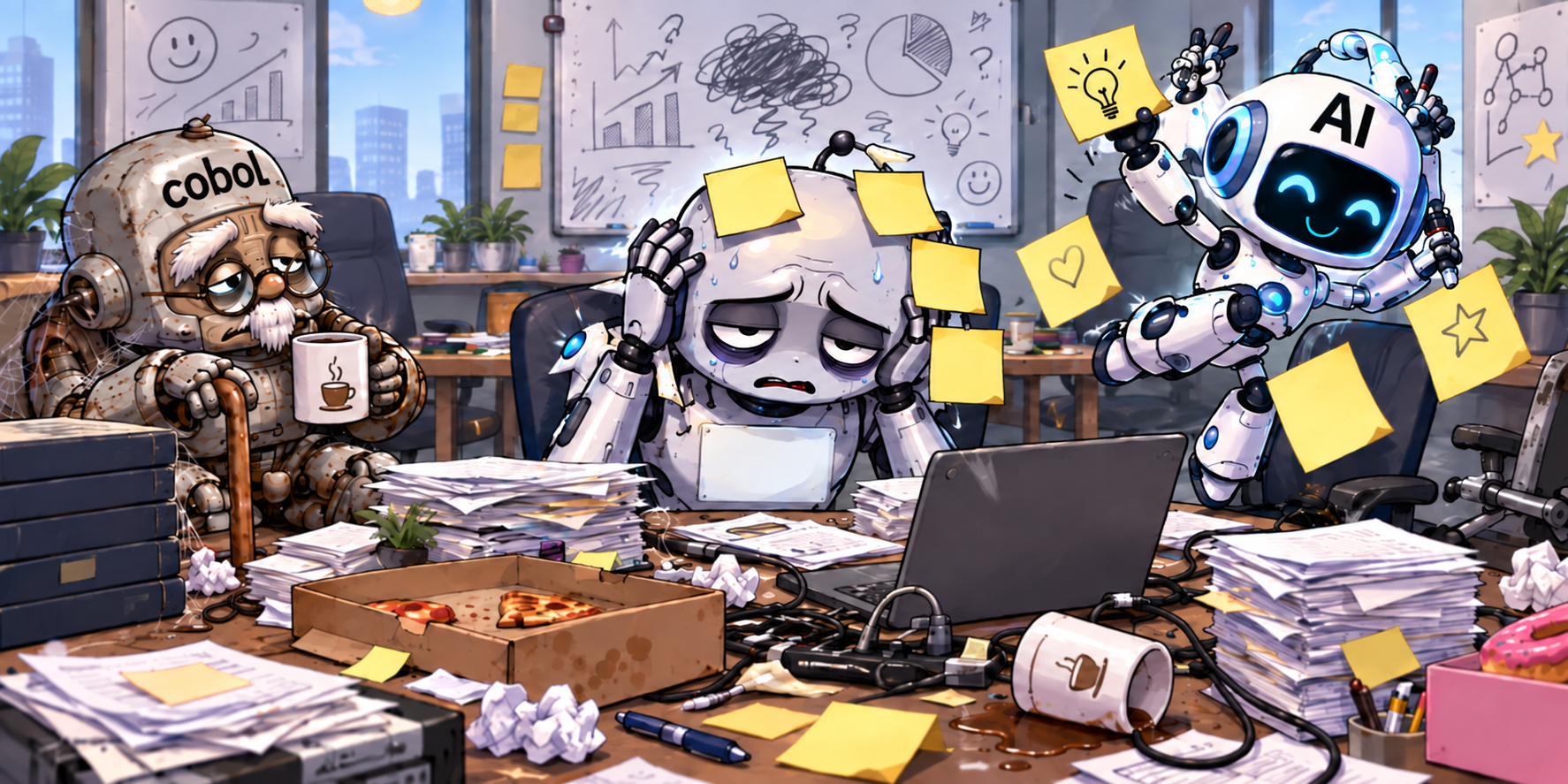
The phenomenon of modernization in financial services in the recent decades has been largely attributed to technology transfers.
Shift workloads to non legacy platforms. Avoid any proprietary middlewares and stick to APIs. Break up monolithic apps into services. Adopt cloud infrastructure. Implement older programming languages in to newer tech stacks.
The hard bits of modernization are which of those changes is significant and which isn’t.
The most challenging component is to keep the knowledge that the enterprise already has.
A mature financial platform has so much more to offer than just source code. It holds a wealth of business rules, exception handling rules, settlement logic, integration contracts, operational dependencies, reconciliation behavior, security controls, regulatory requirements, and institutional knowledge spanning decades. Much of that knowledge isn’t documented in any one place. It’s everywhere, in programs, database schemas, message formats, batch schedules, experience of those that have run these systems for years, operational runbooks, production support procedures, and more.
It is for this reason that modernization projects can be technically successful without generating new operational risk.
The code could have been written recently and the enterprise may not be as knowledgeable of the system as they once were.
The economics of this problem is altered by Artificial Intelligence. With the assistance of LLMs and AI systems for engineering, it is now possible to analyze source code, find dependencies, generate documentation, suggest APIs, write tests and help in software transformation at scale — much more than possible even several years ago.
However, the core modernization challenge doesn’t go away with AI.
This only underscores the importance of having business intent.
The next wave of modernization must now go beyond code transformation to the consistent preservation and evolution of business meaning as systems traverse legacy platforms, APIs and distributed services, cloud environments, data platforms, and AI-driven engineering processes.
How can Enterprise AI revolutionise the modernisation lifecycle?
The best use of Enterprise AI might not be as a code generator.
In terms of the rate of understanding, it’s more valuable.
A lot of a typical modernization effort is spent trying to re-imagine the behavior of an application in order to make that change happen. AI can help reduce that discovery burden in a number of ways.
Application Understanding
Formalizations of programs, modules, interfaces, data structures, interdependencies and workflows can be generated from analysis using AI.
Rather than starting from the millions of lines of code, modernization teams can start with application maps that describe:
- major business functions;
- access to resources; and
- external interfaces;
- database interactions;
- water flow (Q);
- exception-handling behavior; and
- Areas with complex, duplicated and/or architecture at risk.
Nithesh Gudipuri, author of this text, is going to be a speaker during the upcoming Applied AI summit in October. Register now!
Dependency Discovery
There are times that the relationships between legacy systems are difficult to discover solely by analyzing the source—repository.
AI can be employed to establish correlations between the source code, configuration, message definition, database usage, interface specification, architecture documentation, and operational artifacts, and make inferences that likely relate them.
Together with static analysis tools and runtime telemetry, this analysis can be used to create more sophisticated dependency models than those that would likely be generated by deterministic tools or LLM reasoning alone.
Documentation Generation
While documentation is the most obvious use case for Generative AI, the use of Generative AI to create structured architectural knowledge is transformative.
For each application component, an AI-driven modernization pipeline can yield:
- purpose;
- inputs and outputs;
- business rules;
- dependencies;
- interfaces;
- exception conditions;
- operational assumptions;
- security considerations; and
- candidate modernization strategies.
From Code Equivalence to Behavioral Continuity
In traditional modernization, functional equivalence is commonly focused on.
In the legacy system, Input A produces Output B; that should be the same in the modernized implementation, that is, Input A should produce Output B.
That is . . . . . but not enough.
Mission-critical financial platforms demonstrate action on numerous aspects:
- transaction ordering;
- concurrency;
- timing;
- retries;
- idempotency;
- exception handling;
- recovery;
- settlement sequencing;
- audit generation;
- downstream messaging;
- reconciliation;
- authorization; and
- failure conditions.
Enterprise Semantic Continuity
Now, an architectural model needs to be created to span the business meaning across technology generations.
I’m being facetious, but it’s Enterprise Semantic Continuity, in my opinion.
Enterprise Semantic Continuity is the capacity to maintain and follow business intent, the meaning of the domain, the expectation of behaviour and operational relationships and across technological boundaries as systems evolve.
It is very simple:
Technology implementations change. It is necessary to trace the meaning of enterprise.
Further Reading
Author: Nithesh Gudipuri, Neural Modernization for HPE NonStop Systems (NM4N), IJSRP Digital Library. Read the monograph
Nithesh Gudipuri, author of this text, is going to be a speaker during the upcoming Applied AI summit in October. Register now!